PhD Project Summary: Predicting Pipe Failures to Support Renewal Decisions in Water Supply Systems
This PhD project focuses on developing data-driven models to predict pipe failures in water supply systems, with the aim of supporting proactive maintenance and renewal for water utilities. The work combines machine learning with decision-support approaches to enable more effective infrastructure management. This PhD project is part of AquaClim, where the broader focus is on water saving, with a main emphasis on water distribution networks.
The main contribution of this research is the development of data-driven methods to predict future pipe failures and support renewal planning. Rather than only identifying whether a pipe may fail or not, the project aims to provide more practical information about future failure risk. This can help water utilities better prioritize maintenance, inspection, and replacement activities.
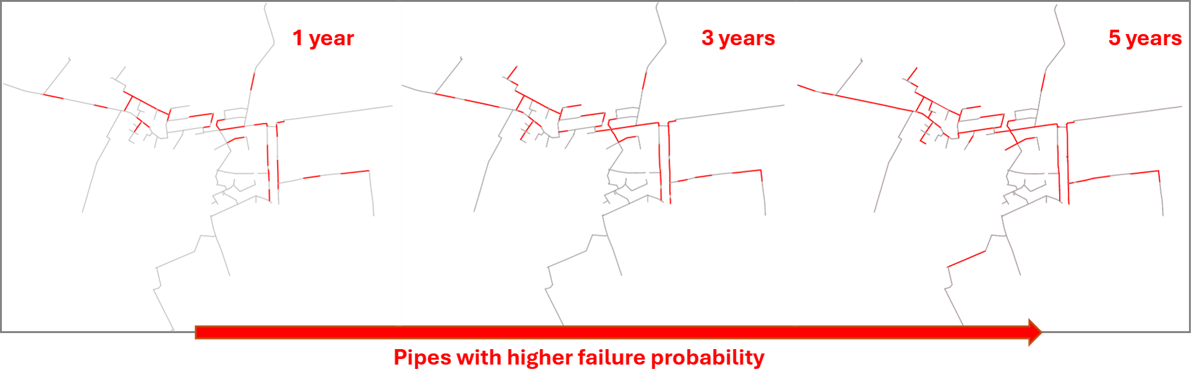
The methods use commonly available water distribution network data, including pipe characteristics, surrounding conditions, and historical failure records. Data-driven models are developed and tested using real-world datasets in collaboration with water utilities in Gothenburg, Skåne, and Uppsala. By learning from historical failures, the models help identify groups of pipes with a higher likelihood of failure in the coming years, supporting proactive planning and renewal decisions.
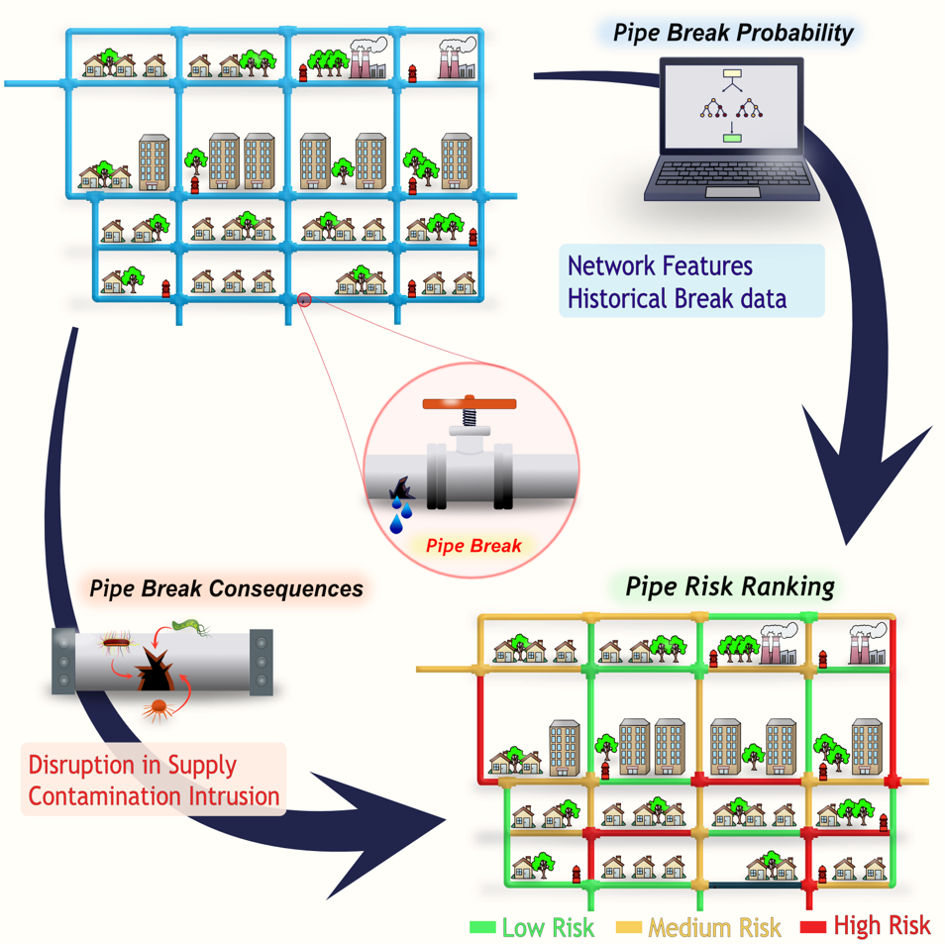
The PhD research has also focused on utilizing predictions together with consequence analysis to translate results into practical actions. In addition to predicting failures, consequence models were developed to assess the potential impacts of pipe breaks. These consequence results were combined with the predicted failure probabilities to estimate overall risk. The resulting risk values are then used to group pipes into different risk levels and visualize them as risk maps, helping utilities prioritize maintenance, inspection, and replacement. A key strength of this research is its practical applicability.
This part of the project was successfully completed through the Licentiate presentation on 29th May 2026. After the Licentiate, the research is shifting toward leakage-related challenges in water supply systems, building on the prediction and decision-support framework already developed. The focus is on improving how leaks are detected and located in real networks, using pressure and flow sensor data to identify unusual system behavior and determine where leaks may be occurring. This will involve exploring and comparing different data-driven approaches, including machine learning and graph-based methods, to improve leakage detection and localization.